Here's how to price pest control jobs: add your time on site to your travel time, multiply by your charge-out rate, add the chemical, bait and materials the job uses, then add GST if you're registered. Termite work, rodent programs and commercial contracts use the same sum, with inspection and report time, monitoring visits and contract frequency added in.
Pricing from your own numbers is what stops a cheap general spray from quietly costing you money. This guide covers how to price pest control jobs of every kind, from a house treatment to a termite barrier to a monthly cafe contract, with a worked example you can swap your own figures into, and how to present the price so the customer says yes.
What goes into the price of a pest control job?
Every pest control price has five parts: time on site, travel, chemical and materials, a margin on those materials, and GST. Time and travel are charged at your charge-out rate, which already covers your wage, the ute, insurance, licences and profit. The chemical is costed per job from what you actually apply. Leave out any part and the job pays less than you think.
As a formula:
Price = (hours on site + travel hours) x charge-out rate + chemical and materials + materials margin, then GST if registered
The minimum call-out, the report, the warranty call-back and the follow-up visit all come out of the same sum. They just change which hours you're counting.
How do you work out your charge-out rate?
Your charge-out rate is what an hour of your time has to bill to cover your wage, super, the ute, fuel, insurance, licences, equipment, phone and the hours you spend quoting and driving, plus profit. It isn't what you'd pay a technician. Work it out once a year from your own costs, and every price you set after that rests on it.
Our guide to how to price a job works through a charge-out rate step by step. For pest control, make sure the rate carries the costs other trades don't have: your pest management licence, professional indemnity cover if you do inspections, respirators and PPE, a moisture meter or thermal camera, and the hours spent writing records and reports.
How do you work out the chemical cost per job?
Work out the cost per litre of mixed product, then multiply by the litres you apply. Divide the price of the concentrate by how many litres of mix it makes at the label rate. Do the same for gels, dusts and baits by the gram or by the station. Write the figure down once per product and it's quick to cost every job after that.
An example of the working, with made-up numbers. Use your own product's price and its label rate, never these:
- The concentrate. A 1 litre bottle costs $200.
- The mix. At the label rate it makes 200 litres of spray.
- Cost per litre of mix. $200 divided by 200 litres is $1.
- On the job. You apply 15 litres around a house, so the spray costs $15.
- Add the rest. Gel and dust for the kitchen and roof void come to $3, so the job's chemical is $18.
The label sets the rate, not the budget. Never thin the mix to bring a price down. Price the job properly instead.
What should a minimum call-out cover?
A minimum call-out is the least you charge to attend at all, whatever the job turns out to be. It should cover the travel there and back, setting up, the first block of time on site, PPE and the record you have to write afterwards. Set it from your own rate so a five-minute wasp nest still pays for the hour it really took.
A common way is a fixed minimum that includes a first block of time, then charge in smaller blocks after that. Say on the quote or the booking what the minimum includes. If you take after-hours or weekend emergencies, set a separate after-hours call-out, because that hour costs you more.
How do you price a general pest treatment?
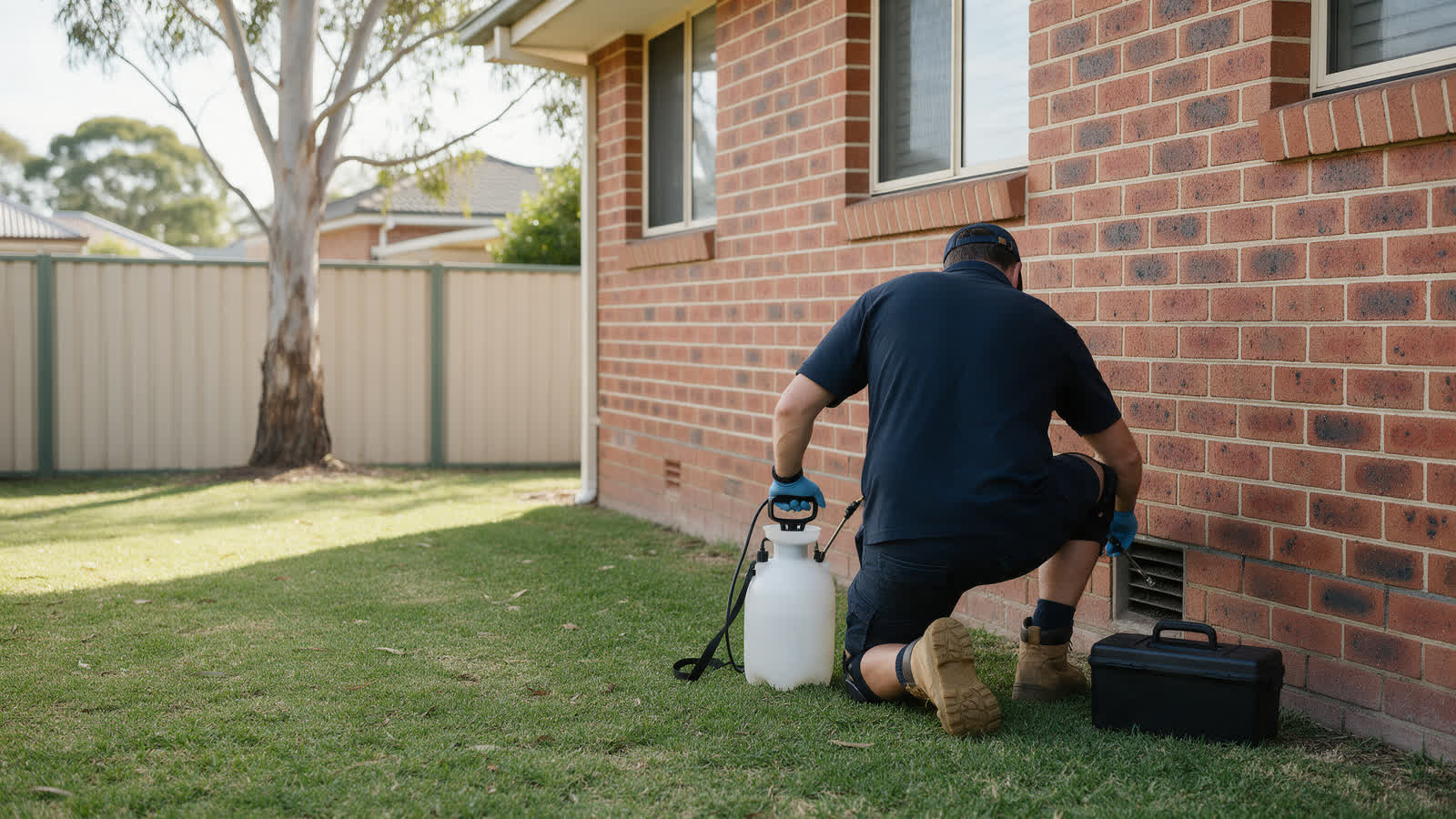
Price a general pest treatment from the size and access of the property: how long the internal treatment, the external spray, the roof void and the subfloor will take, plus travel and chemical. A single-storey house with easy access is the base. A two-storey place, a big block, a heavy infestation or a tight subfloor adds time, so it adds to the price.
Here's the worked example. The numbers are placeholders to show the working, not market rates.
| Line | Example working | Example amount |
|---|---|---|
| Time on site | 1 hour at $110 an hour | $110 |
| Travel | 30 minutes at $110 an hour | $55 |
| Chemical and materials | From the cost per job worked out above | $18 |
| Subtotal | $110 + $55 + $18 | $183 |
| Rounded price before GST | $185 | |
| GST at 10 percent | Only if you're registered | $18.50 |
| Price with GST | $203.50 |
Then set your add-ons the same way: the extra time for a second storey, a granny flat, a big garden or a heavy cockroach clean-out, each priced from the minutes it adds. Once those are written down, quoting a house over the phone takes a minute and gives the same answer every time.
How do you price a termite inspection?
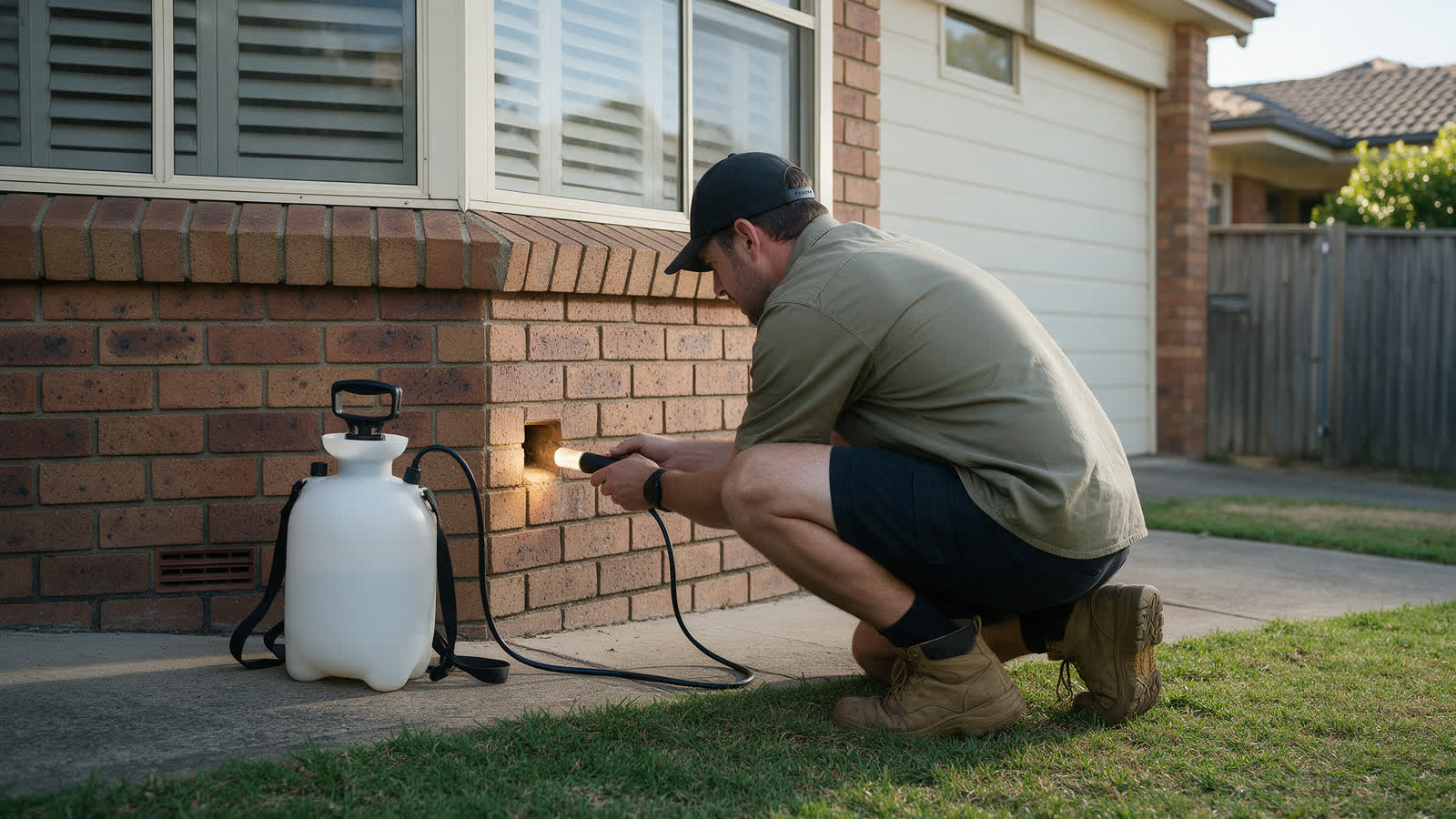
Price a termite inspection on the hours it really takes: the inspection itself, access to the roof void and subfloor, the tools, and the time to write the report. Report writing often takes as long as the inspection, so count it. A bigger house, a raised floor, a slab with no access or a timber-heavy garden all add time, and the price should say so.
Know which job you're quoting. Inspections as part of ongoing termite management sit under AS 3660.2-2017, Termite management in and around existing buildings (Standards Australia). Industry notes on that edition say regular inspections should be no more than 12 months apart (AEPMA's notes), which makes the annual inspection a natural service to book every year. A pre-purchase timber pest inspection for a buyer is different work, under AS 4349.3-2010, Timber pest inspections (ABLIS), with its own report and usually a tighter deadline. Price the deadline in.
How do you price termite barriers and baiting systems?
Price a chemical termite barrier by the linear metre of perimeter: the product volume per metre at the label rate, plus the labour to trench, drill and inject. Price a baiting system as the install, the stations times your cost plus the labour, and then the monitoring visits for as long as the program runs. Both start with an accurate perimeter measurement.
For a barrier, measure the perimeter off the plan or on site, then build a rate per metre from your product cost and the time a metre takes in soil, and the slower time a metre takes through concrete paths and slabs. Price drilling and patching concrete as its own line, because it's the part that blows out.
For baiting, the install is only the start. AEPMA's notes on AS 3660.2 say monitoring services should be no more than three months apart. So a baiting quote is really a year of visits. Show the install price and the monitoring price per visit, and the yearly renewal, so the customer isn't surprised in month four.
How do you price rodent programs and commercial contracts?
Price rodent programs and commercial contracts per visit, then multiply by the frequency. Each visit is time on site checking stations, travel, bait used and the report the client needs, all at your rate. Add the costs particular to commercial sites: sign-in and inductions, after-hours access, audit paperwork and any extra visits the contract promises when there's activity.
| Contract | What drives the price | Price it as |
|---|---|---|
| Home rodent program | Number of stations, follow-up visits | Install plus each follow-up |
| Cafe or restaurant | Visit frequency, stations, audit records, after-hours access | Per visit, billed monthly |
| Warehouse or factory | Size, station count, induction time, lifts or ladders | Per visit, billed monthly |
| Strata common areas | Notice requirements, number of buildings | Per visit, plus call-outs at your normal rate |
Write a contract with the visit frequency, the pests covered, the stations by number, what a call-out between visits costs, the term and a yearly price review. Commercial clients expect a price per visit or per month, not a pile of hourly lines.
Do you charge GST on pest control?
If your business is registered for GST, add 10 percent to the price and issue a tax invoice. You must register once your GST turnover reaches $75,000 a year, and you can register earlier if you choose. If you're not registered, don't charge GST. Show it clearly on the quote so the customer knows whether the price includes it.
The ATO's registering for GST page has the rules. Quote homeowners a price that includes GST, since that's what they pay. Commercial clients often want it shown separately.
What warranty or re-treat terms should you offer?
State the warranty in writing: how long it lasts, which pests and which areas it covers, and what the customer must do to keep it, such as not spraying over your treatment, keeping garden beds off a barrier or booking the annual inspection. Then price the expected call-backs into the job, so a free re-treat doesn't come out of your profit.
A general treatment commonly carries a short warranty on crawling insects, with a free re-treat if they come back inside that period. Termite work carries longer terms tied to the inspections. Whatever you offer sits on top of the guarantees under Australian Consumer Law, which apply anyway. Write the terms on the quote, so the customer agrees to them when they agree to the price.
How do you present a pest control quote so the customer says yes?
Send the quote the same day, in plain words: what you'll treat, where, with what kind of product, the price with GST, the warranty and when the next service is due. Offer two options where it fits, such as a one-off treatment or a yearly plan. Then follow up within a few days if you've heard nothing.
The customer comparing three quotes usually picks the one they understand. Make it easy:
- Scope in plain words. "Internal treatment to kitchen, bathrooms and laundry, external spray to the perimeter, eaves and fences, dust to the roof void."
- Safety and re-entry. How long to stay out, and what to do about pets and fish tanks.
- The warranty. The period, and what keeps it valid.
- The next visit. When the follow-up or the annual inspection is due, and roughly what it costs.
When the phone rings during termite season and you're under a house, the AI receptionist answers in your business name, takes the job, address and urgency, and texts you the rundown. If a caller asks what a treatment costs, it gives the starting prices on your price list, never a total, so the quote stays yours to write.
Pricing from memory
- A different price for the same house depending on the day
- Chemical cost guessed, or forgotten
- Report time given away
- The follow-up treatment never booked
Pricing from your numbers
- Your rate, your chemical cost and your add-ons in the price book
- Every quote built from the same templates
- Inspection and report time counted
- A service reminder set on the first visit
Once the job's done, the record matters as much as the price. Our guide to pest control treatment records covers what to write down after every treatment. If you want your prices sitting ready the next time someone asks for a quote, start your 14-day free trial and load your treatments tonight.
Questions
Work it out from your own costs: time on site plus travel at your charge-out rate, plus the chemical you apply, then GST if you're registered. Size, storeys, access and how bad the infestation is change the time, so they change the price.
By the linear metre of perimeter. Build a rate per metre from the product at its label rate plus the labour to trench, drill and inject, then price drilling and patching concrete as a separate line.
Ongoing termite management inspections sit under AS 3660.2-2017, Termite management in and around existing buildings. Pre-purchase timber pest inspections are done to AS 4349.3-2010, Timber pest inspections.
If you're registered for GST, yes: add 10 percent and issue a tax invoice. Registration is required once your GST turnover reaches $75,000 a year. If you're not registered, you don't charge GST.
Yes. Set a minimum that covers travel, setup, a first block of time on site, PPE and the record you write afterwards, so a quick job still pays for the hour it takes. Charge more for after-hours call-outs.