Here's how to start a cleaning business in Australia: get an ABN, register a business name if you won't trade under your own, take out public liability insurance, buy a basic kit, set an hourly rate from your own costs, and find your first handful of regular clients. You can start as a sole trader with a car, a caddy and a phone, and most cleaners do.
The setup takes a week or two. What decides if you're still going in two years is the part after it: prices that cover the real costs, regulars who stay on the run, and invoices that get paid. This guide covers both, in the order you'll hit them.
What do you need to start a cleaning business in Australia?
You need an ABN, public liability insurance, a reliable car, a starter kit of equipment and products, a price list worked out from your own costs, and a way to book jobs and send invoices. A business name, GST registration and a police check come in when your situation calls for them. None of it needs a big upfront spend.
Work through this list before your first paid clean:
- ABN, applied for free through the Australian Business Register
- Business name registered with ASIC, if you trade under anything other than your own name
- A business bank account, kept separate from your personal one
- Public liability insurance, with a certificate of currency you can email
- A national police check, if you'll be holding keys or cleaning homes while people are out
- Equipment and products for the type of cleaning you'll do first
- An hourly rate worked out from your costs, and a set price for your common cleans
- A way to send quotes and invoices with your ABN on them
- A phone number you'll actually answer, or something that answers it for you
Do you need an ABN and a business name to start cleaning?
Yes, you need an ABN to run a cleaning business, and it's free. You apply on the Australian Business Register, and business.gov.au explains what to have ready: your business structure, proof of identity and what the business does. A business name only needs registering if you trade under something other than your own name, and you register it with ASIC.
The guides are on business.gov.au: register for an ABN and register your business name. A business name registered with ASIC covers the whole country, so there's no separate state registration.
Check the name is free before you print anything. Search it on ASIC's register, check the domain and the Facebook page name, and make sure nobody nearby is already cleaning under something close. Changing a name after the car is signwritten costs more than checking first.
Should a cleaning business be a sole trader or a company?
Most cleaners start as a sole trader because it's cheap and simple. You use your own tax file number, the profit is your income, and the paperwork is light. A company costs more to set up and run, but it's a separate legal entity. Plenty of owners move to one once there are staff, contracts and real money involved. Talk to your accountant before you switch.
| Sole trader | Company | |
|---|---|---|
| Setup | An ABN, free | Registered with ASIC, with a yearly fee |
| Tax | Profit is taxed as your personal income | The company pays its own tax, and pays you from it |
| Who's responsible | You, personally, for everything | The company, as a separate legal entity |
| Paperwork | Light | More: company records, separate accounts, director duties |
| Suits | Starting out alone or with one helper | Growing with staff and commercial contracts |
business.gov.au has a plain rundown of each business structure. Its line on sole traders sums it up: you're legally responsible for all of it.
When does a cleaning business have to register for GST?
You must register for GST once your GST turnover reaches $75,000 a year, or when you expect it to within the next 12 months. Below that, registering is optional. Once you're registered, you add 10 percent to your prices, issue tax invoices and lodge a BAS. You have 21 days to register after you go over. The ATO's GST registration page has the full rules.
Plan for it early. If you have twenty regulars on a set price and you cross the line mid-year, every one of them either pays 10 percent more or you swallow it. Setting your prices with GST in mind from the start makes that day a lot less awkward.
What insurance does a cleaning business need?
Public liability insurance is the one to have before your first clean. It covers you if someone is hurt or their property is damaged because of your work, like a client slipping on a wet floor or a stone benchtop etched by the wrong product. Workers compensation is required by law once you employ staff. Commercial clients and strata managers will usually ask for your certificate of currency before you start.
business.gov.au lists the main types of business insurance, and notes that some states require public liability for certain occupations. Two more to think about: cover for the gear in your car, and income protection if you're the only one earning. Before you buy, ask your first commercial client what amount of cover their contract needs, because some set a minimum.
Do cleaners need a police check in Australia?
No single rule makes every cleaner get one, but plenty of clients ask, especially for home cleaning where you hold keys or work while they're out. Get one before you start advertising and say so in your ads and on your quotes. It answers the question before the client has to ask it. Work in schools, aged care or for NDIS participants comes with its own screening rules.
You can apply online for a national police check through the AFP. Keep the certificate somewhere you can send it from your phone, because a property manager or a new client will ask for it at the worst possible moment.
Residential, commercial or end-of-lease: where should you start?
Most new cleaners start with residential regulars, because the work is steady, the cleans are short and word spreads fast between neighbours. End-of-lease pays more per job but is one-off and judged by an agent. Commercial work brings contracts and after-hours runs, but expects insurance, procedures and reliability from day one. Start with one, then add the others as the diary fills.
| Type | The work | What it pays like | What to watch |
|---|---|---|---|
| Residential regulars | Weekly or fortnightly cleans of the same homes | Steady, with short drives if you keep clients close together | Cancellations, keys and alarm codes |
| End-of-lease | One-off deep cleans when tenants move out | More per job, less often | The agent's inspection, re-cleans, weekend deadlines |
| Commercial | Offices, shops, clinics and gyms, often after hours | Contracts and a regular monthly invoice | Tenders, insurance minimums, penalty rates once you hire |
| Short-stay turnovers | Cleans between guests for holiday rental hosts | Regular volume from one host | Tight windows, linen, same-day changes |
A lot of cleaners use end-of-lease jobs to fill the gaps in the week while the regular book builds up.
What equipment and products do you need to start?
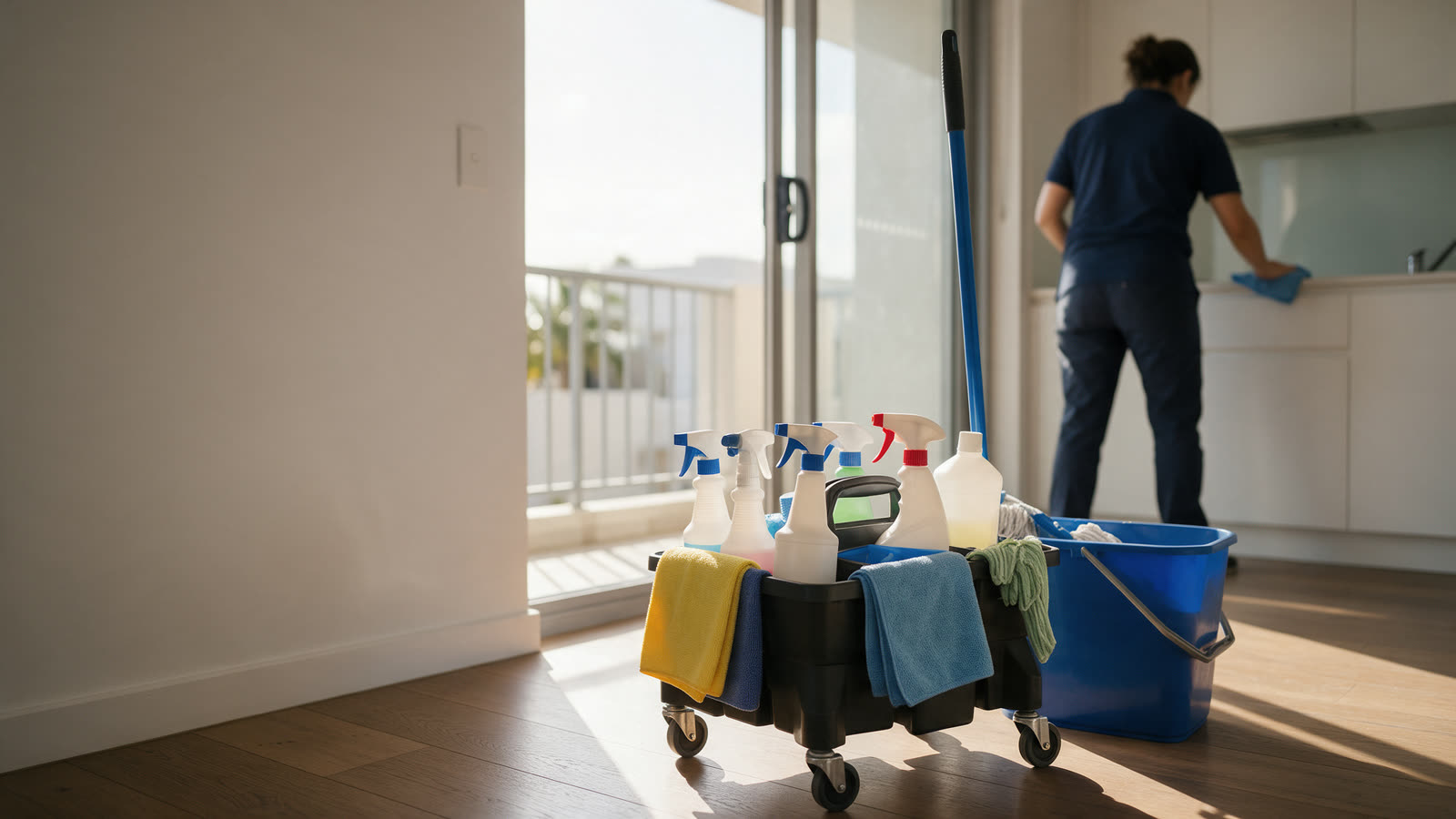
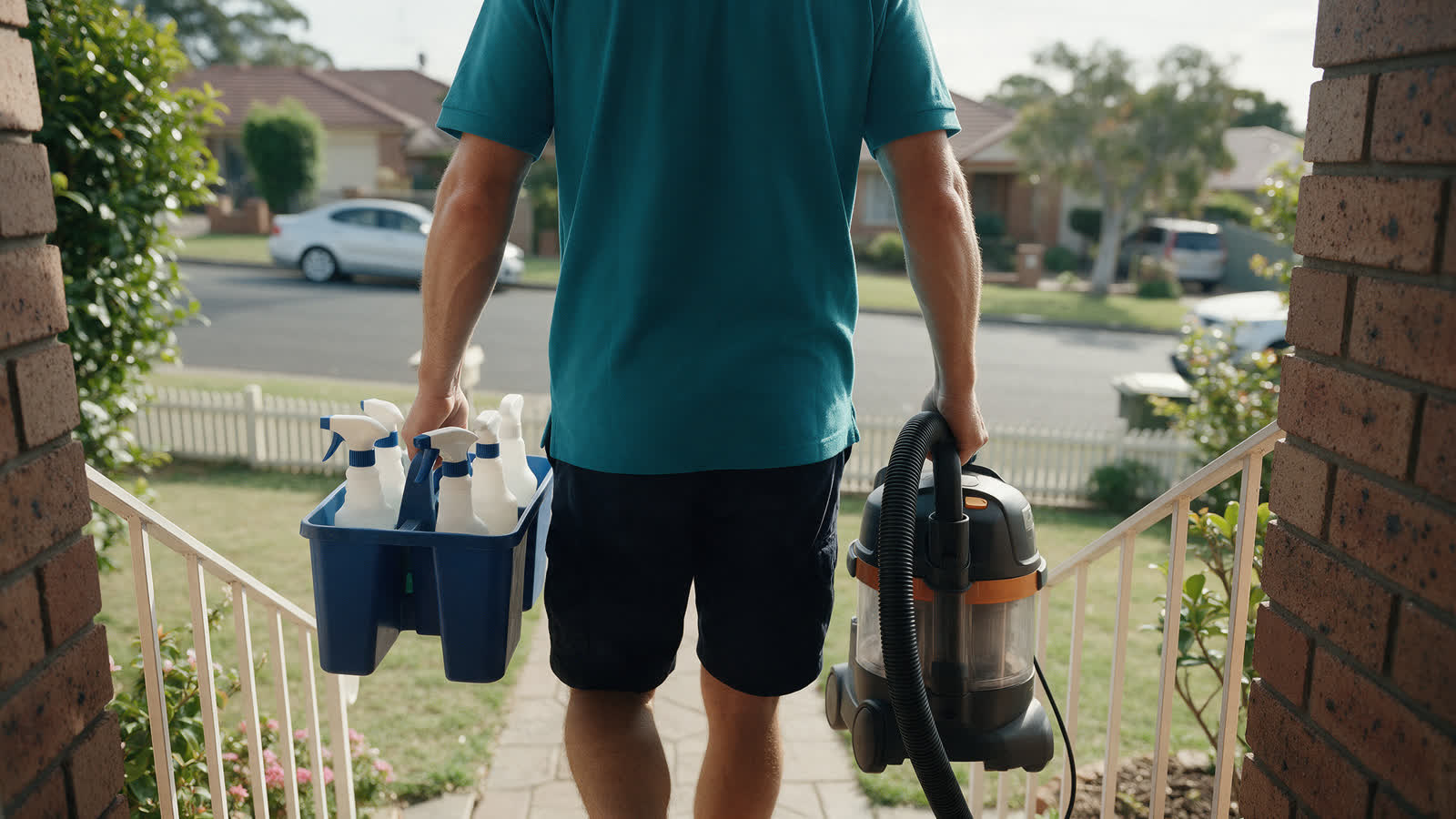
Start with a kit that does a standard home clean properly, and buy specialist gear only when a job pays for it. A good vacuum, a mop system, colour-coded microfibre cloths, a caddy and a small range of products covers most residential work. Carpet steam cleaners, floor scrubbers and window poles can be hired, or bought once the work is there to pay them off.
- A commercial-grade vacuum, backpack or canister, with a HEPA filter
- A mop and bucket system, with separate mop heads for kitchens and bathrooms
- Microfibre cloths in at least three colours: kitchen, bathroom, everything else
- A caddy for the trip from the car to the house
- An all-purpose cleaner, a bathroom cleaner, a degreaser, glass cleaner, a disinfectant and a neutral floor cleaner
- Scrubbing brushes, scourers, a grout brush, a squeegee and an extendable duster
- Gloves, and the safety data sheet for every chemical you carry
- Bin liners, a step stool and a couple of drop sheets
- Tubs or crates to keep wet gear off the car seats
How should you price cleaning jobs?
Price from your own costs, not from the cheapest ad on Facebook. Work out what an hour of cleaning costs you to deliver, including fuel, products, insurance, phone and the unpaid time spent driving and quoting, then add profit. That's your hourly rate. Every clean is then the hours times the rate, plus products and extras, plus GST if you're registered.
Work out your hourly rate
Pick your yearly pay.
What you want to earn before tax for a full year of work.
Add your yearly costs.
Insurance, fuel, the car, products, equipment, phone, software and the accountant.
Count your billable hours.
Hours actually cleaning, not driving or quoting. Take out holidays, sick days and the quiet weeks.
Divide.
Pay plus costs, divided by billable hours, is what each hour has to bring in.
Add profit.
A margin on top, so the business can replace the vacuum and ride out a slow month.
Here's the sum with round numbers, so you can see it work. Swap in your own. Say you want to pay yourself $60,000, your costs come to $15,000, and you'll bill 1,250 hours in the year. That's $75,000 divided by 1,250, or $60 an hour before profit. Add 15 percent and your rate is $69 an hour. At that rate across those hours you'd turn over $86,250, which is past the GST line, so you'd price with GST in mind from the start.
To turn the rate into a price for a particular clean, with a worked end-of-lease example, read how to quote a cleaning job. The longer version of the rate sum is in how to price a job.
Be careful with discounts for regulars. A small reduction for a weekly booking makes sense because it fills your week, but the rate still has to clear what an hour costs you.
Where do your first cleaning clients come from?
Your first clients usually come from people who already know you, then from their neighbours. Tell everyone you've started, set up a free Google Business Profile, post in local community Facebook groups that allow business posts, and letterbox the streets around your first clients. Ask every happy client for a Google review and a referral. Then turn up on time, every time.
- Friends, family and old workmates. Tell them what you do, the suburbs you cover and how to book. Ask them to pass it on.
- Google Business Profile. It's free, and it's where "cleaner near me" searches land. Set the service area to the suburbs you want to work in. Google has a setup guide.
- Local Facebook groups. Check the rules first. A plain post with a photo of real work beats a flyer graphic.
- Letterbox drops near your regulars. Every street with one client is a street you're already driving to.
- Property managers. End-of-lease work comes through them. Drop in, leave a card, and make the first job perfect.
- Reviews. Ask on the day, by text, with a direct link to your review page.
The biggest leak early on is the phone. Someone rings while the vacuum's running, gets voicemail, and rings the next cleaner on the list. More on all of this in how to get more work as a tradie.
How do you keep regular cleaning clients?
Regular clients stay when the clean is consistent, you turn up when you said you would, and nothing needs chasing. Book the next visit before you leave, send a reminder before each visit, keep notes on each home, and tell the client early if anything changes. Plenty of regulars aren't lost to a cheaper price. They drift off after a missed week nobody rebooked.
- Keep a note for each home: keys, alarm code, pets, products they don't want used, rooms to skip
- Send the same cleaner to the same home where you can
- Text a reminder before each visit, so you're not knocking on a locked door
- If a clean has to move, tell the client that day and offer a new time
- Invoice on a set rhythm, after each clean or once a month, and stick to it
- Review your prices once a year, and give notice before they change
When should you hire your first cleaner?
Hire when you're turning work away every week or your own hours are full for weeks ahead, not after one busy fortnight. Cleaners you employ are generally covered by the Cleaning Services Award 2020 (MA000022), which sets minimum pay, casual loading, penalty rates and allowances. You'll also need workers compensation insurance, super paid with each pay run, and payslips for every pay.
Read the Cleaning Services Award on the Fair Work site and check the current pay rates before you set wages. Rates usually change on 1 July each year. Penalty rates for evenings and weekends make a big difference to after-hours commercial cleaning, so build them into the price of those contracts before you hire for them.
Before the first person starts:
- Workers compensation from an authorised insurer in your state
- Their tax file number declaration and super fund details
- Super at 12 percent, paid with each pay run under Payday Super
- A written checklist for each site, so a new cleaner does it your way
- A process for keys and alarm codes that doesn't rely on memory
If you'd rather use subcontractors, check they'd really count as contractors. Fair Work and the ATO look at how the work is actually done, not at what the agreement calls it.
What should you look for in cleaning business software?
Look for software that handles what a cleaning business does over and over: quoting a clean from saved prices, booking regulars into a diary, reminding clients before a visit, invoicing small amounts and chasing the ones that go overdue. It has to work properly on a phone, because that's where you'll use it, and it should be priced for a small team.
Questions to ask before you pick one:
- Can you save your standard cleans and send a quote from the car?
- Can a client accept the quote on their phone?
- Can you copy a regular's clean for next week in a couple of taps?
- Does it remind clients before a visit?
- Does it chase overdue invoices by itself, by email and text?
- Can your cleaners log their own hours?
- Does it answer the phone when you can't?
- Can you trial it on real jobs before paying?
Galaxera is cleaning business software built in Australia around that list. If you're setting up now, set the admin up once, properly. Start a 14-day free trial, no card needed, put in your rates and your first few regulars, and send your next quote from it.
Questions
General house and office cleaning doesn't need a trade licence. You need an ABN, and in practice public liability insurance, because most clients and every commercial contract will ask for it.
Only once your GST turnover reaches $75,000 a year, or you expect it to within 12 months. Below that it's optional. Once registered, you add 10 percent to your prices and lodge a BAS.
Public liability insurance before your first clean, and workers compensation once you employ anyone. Cover for your equipment and income protection are worth pricing too.
Start with people who know you, then a free Google Business Profile, local Facebook groups and letterbox drops around your first clients. Ask every happy client for a review and a referral.
Most employed cleaners are covered by the Cleaning Services Award 2020, code MA000022. Check the current rates on the Fair Work site before you set wages.