Here's how to quote a cleaning job: work out how long it will take your team, multiply by your hourly rate, add products and any extras, then add GST if you're registered. Whether you show the customer an hourly rate, a fixed price or a rate per square metre, the sum underneath is the same: hours, rate, materials, margin.
The hard part isn't the maths. It's seeing the job properly before you price it, so a "quick" end-of-lease doesn't turn into nine hours on a Saturday. This guide walks through the three ways cleaners quote, what to check on the walk-through, and a worked example you can copy.
Three ways to price a clean
| Method | Suits | Watch out for |
|---|---|---|
| By the hour | Regular domestic cleans, one-off jobs that are hard to size | Customers want a total, and a slow clean looks expensive |
| By the job (fixed price) | End-of-lease, move-in, one-off spring cleans | Underquote the condition and you wear the extra hours |
| By the square metre | Commercial sites, offices, carpet and hard-floor work | Rates per m² hide very different jobs: a kitchen isn't a hallway |
Most cleaning businesses use all three. They work out the hours either way, then present the price in the form the customer expects. A property manager wants a fixed end-of-lease price. A building manager tendering an office wants a rate per square metre. A regular wants to know the hourly rate and how many hours.
Start from your own hourly rate
Every method rests on one number: what an hour of cleaning costs you, plus margin. That isn't the wage you pay. It has to cover the wage, super, insurance, fuel, products, equipment, phone and the unpaid hours spent quoting and driving, and still leave profit.
If you've never worked it out, our guide to how to price a job takes you through a charge-out rate step by step. Do it once and every quote after it gets easier.
For context, one Australian cost guide puts Sydney contract office cleaning at about $40 to $70 an hour and end-of-lease cleans at roughly $6.50 to $15 per square metre in 2026 (cost guide). Treat ranges like these as a sense check, not as your price. Your rate comes from your costs.
What to check on the walk-through
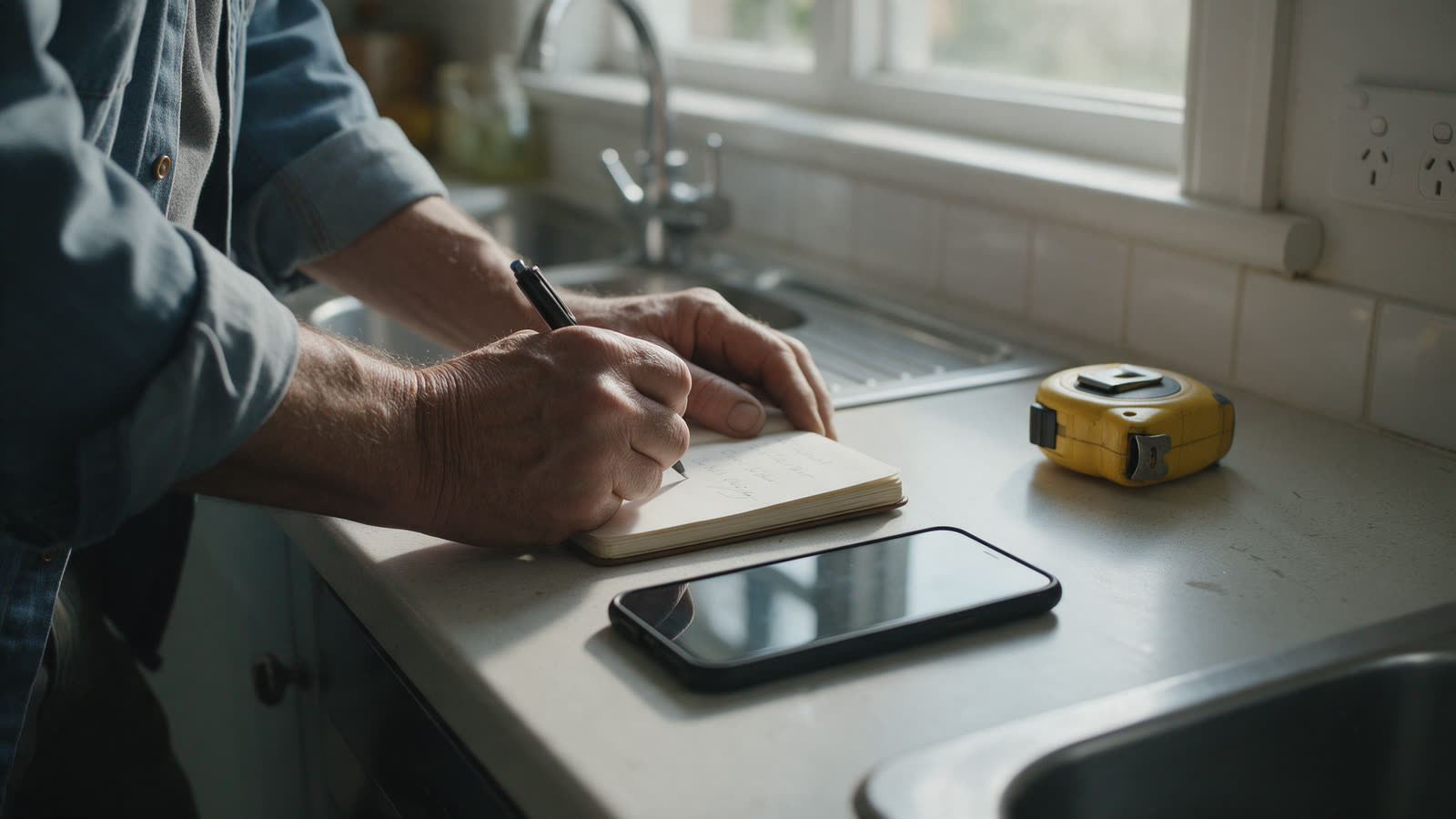
The walk-through is where good cleaning quotes are won. Look at the place, or ask for photos and a video if you can't get there, and write down:
- Size: bedrooms, bathrooms, living areas, and the floor area if you price by the m²
- Condition: grease in the kitchen, soap scum, mould, pet hair, anything left behind
- Floors: carpet that needs steam cleaning, tiles, timber, vinyl
- Extras: oven, rangehood, inside cupboards, windows and tracks, walls, blinds, balcony
- Access: stairs, lifts, parking, keys, and whether power and water are on
- Timing: the date the keys go back, and whether the agent's inspection has a deadline
- Who pays: the tenant, the owner or the agency, and where the invoice goes
Photos of the condition protect you later. If the customer says "it wasn't that bad", the photo says otherwise.
A worked end-of-lease quote
Here's a typical two-bedroom unit, about 75 m², priced from your own rate. Swap in your numbers.
6 hours
Two cleaners for 3 hours
$588.50
Total including GST
75 m²
Two-bed unit, one bathroom
- Labour. You estimate the clean at 6 hours of labour: two cleaners for 3 hours. At a charge-out rate of $65 an hour, that's $390.
- Carpet. The two bedrooms have 30 m² of carpet to steam clean at $4 per m², which is $120.
- Products and consumables. $25 for this job.
- Subtotal. $390 + $120 + $25 = $535.
- GST. If you're registered, add 10 percent: $53.50.
- Total. $588.50 including GST.
Write the scope into the quote so there's no argument at handover: what's included (oven, rangehood, inside cupboards, windows inside, carpet steam clean), what isn't (walls, outside windows, rubbish removal), and how long the price is valid. If the agent rejects an area, say on the quote whether you'll come back and fix it at no charge, and how soon.
Regular cleans: price the visit, then the run
For weekly and fortnightly regulars, price a single visit first (hours times rate, plus products), then decide whether to offer a lower rate for a set schedule. A regular is worth less per hour than a one-off but far more over a year, and it fills your diary on the days one-offs don't.
Keep regulars on the run. The ones that quietly drop off are usually skipped once in a busy fortnight, then never rebooked. Book the next visit before you leave.
Commercial quotes and tenders
A commercial client wants three things on the quote: the scope by area, the frequency, and a clear price per visit or per month. Measure each area in square metres, list what's done each visit (vacuum, mop, empty bins, wipe kitchen benches, clean toilets) and what's done weekly or monthly (windows, high dusting, carpet spot cleans).
After-hours work costs more, because penalty rates under the Cleaning Services Award apply. Build that into your hourly rate for the job, or the contract price will look fine on paper and lose money every night.
Send it fast, follow it up
Quote the same day if you can. Customers asking for end-of-lease cleans are usually asking three businesses, and the first clear, professional quote often wins. Follow up two days later if you haven't heard back.
Quoting from the car
- Notes on your phone, photos in your camera roll
- Type the quote at home after the last clean
- Work out GST on a calculator
- Send it tonight, maybe tomorrow
With Galaxera
- Photos and notes on the customer's job
- Your standard cleans saved as templates, rates in your price book
- GST worked out and labelled for you
- Quote sent from the car park as a branded link
Where Galaxera fits
The short version
Work out the hours, multiply by your own charge-out rate, add carpet, extras and products, then GST. Present it as an hourly, fixed or per-square-metre price depending on the customer. See the condition before you price it, write the scope and exclusions on the quote, and send it the same day.
Questions
Work it out from your own costs: estimate the labour hours, multiply by your charge-out rate, add carpet steam cleaning, extras and products, then GST if you're registered. Published price ranges are a useful sense check, but the condition of the property matters more than its size.
Work out the hours either way, then present the price the way the customer expects. Domestic regulars usually want an hourly rate, end-of-lease customers a fixed price, and commercial clients a rate per square metre or per visit.
If your business is registered for GST, you add 10 percent and issue a tax invoice. You must register once your GST turnover reaches $75,000 a year. If you're not registered, you don't charge GST.
Your business name and ABN, the address, the scope room by room, what's excluded, the price with GST shown, how long the quote is valid, and what happens if the agent rejects an area.